The Margin Call
Learning about the Margin Call and its implications
2 min read
What is a Margin Call in Trading and How to Avoid Account Liquidation?
Leveraged trading has revolutionized financial markets. Today, trading derivatives, futures, or cryptocurrencies allows traders to multiply their purchasing power and maximize their gains. However, this benefit carries an implicit mathematical risk that separates professionals from novices: the Margin Call and subsequent account liquidation.
If you trade high-liquidity and volatile assets like Bitcoin (BTC), the Nasdaq 100, or Gold, understanding the mechanics behind maintenance margin is your only defense against the total loss of your capital.
Understanding the Concept: What Exactly is a Margin Call?
When you decide to open a leveraged position (whether LONG or SHORT), you are not using only your own money. You are providing a fraction of the total value of the trade (Initial Margin), and the broker or exchange lends you the rest.
As the market fluctuates, your position will generate floating profits or losses (unrealized PnL). If the asset price moves in the opposite direction of your analysis, those floating losses are not deducted from the money the broker lent you; they are subtracted directly from your initial capital.
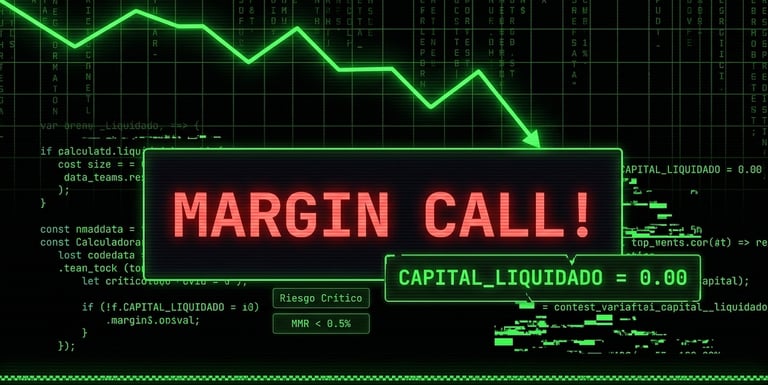
A Margin Call is an automatic alert from the broker's risk system. It occurs when your available capital falls below the required Maintenance Margin. Basically, the exchange is telling you: "Your losses are about to consume your collateral. Deposit more funds immediately or we will close your trade."
The Imminent Danger: The Liquidation Price
In traditional markets, a Margin Call gave you time to transfer money to your account. In today’s ecosystem of crypto assets and high-frequency futures, everything is automated and happens in milliseconds. If you ignore a Margin Call and the market continues to fall (or rise, if you are in a Short), the system will execute Liquidation.
What happens during a liquidation? The exchange's engine takes control of your account, forcibly closes your position at the current market price, and confiscates your initial margin to cover the loan you were granted. Your trading balance is left at zero.
3 Golden Rules to Survive Leverage
To become a consistent trader and prevent the market from devouring your funded account or personal capital, you must apply strict institutional risk management rules:
Calculate risk before executing: Never open a trade "blindly." You must know your exact Liquidation Price before pressing the buy or sell button. If you trade with 50x or 100x leverage, your margin for error is minimal.
Use a non-negotiable Stop Loss: The Stop Loss (SL) is your life insurance. This invalidation level must be placed technically and should always be situated before reaching your liquidation price. Taking a controlled loss of 1% or 2% allows you to trade the next day; a liquidation takes you out of the game.
Control Position Sizing: Do not leverage your entire portfolio in a single trade. Use risk calculators to determine how many contracts or lots you should use based on the distance to your Stop Loss, ensuring that a losing trade does not affect your financial structure.
Volatility is a trader's best friend, as long as it is accompanied by millimetric risk management. Anticipate the market, know your numbers, and protect your capital against sharp movements.
Aston Capital Corp.
FL, United States
Contact
Newsletter
© 2026 Aston Capital Corp. All rights reserved.