Cross vs. Isolated Margin
Difference between margin types and their comparison
2 min read
Differences between Cross Margin and Isolated Margin: Which One to Choose for Trading?
When you open a derivatives trading platform on exchanges like Binance, Bybit, or Bitget, one of the first settings you must choose before placing an order is the margin type: Cross Margin or Isolated Margin.
Selecting the wrong option without understanding the mathematics behind it is the number one mistake that leads traders to lose their entire account balance in a single trade. Below, we break down the key differences and how to use each to your advantage to optimize your risk management.
What is Isolated Margin?
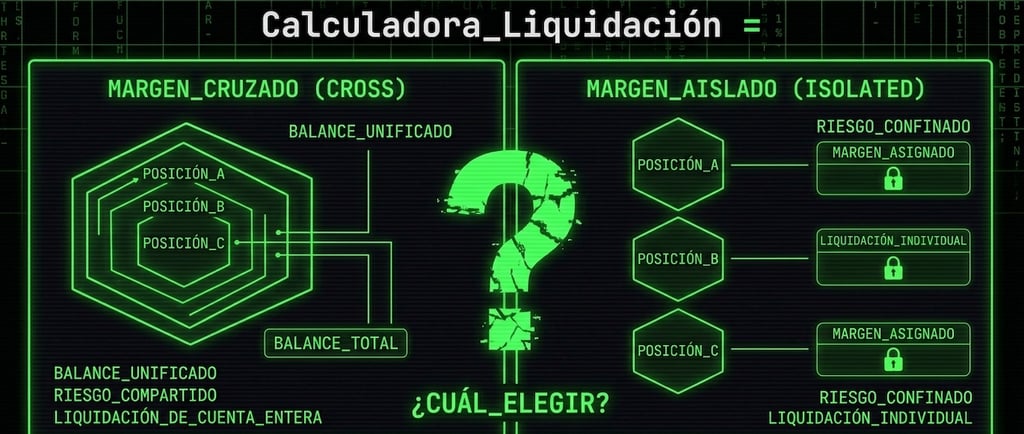
Isolated Margin is the quintessential defensive trading mode. As its name suggests, it "isolates" a specific amount of your capital and assigns it exclusively to a single position.
How does it work? If you have $1,000 in your account and decide to open a Bitcoin trade assigning only $100 in Isolated Margin with 10x leverage, your maximum risk is strictly limited to those $100.
If the market suffers a sudden drop and reaches your liquidation price, the exchange will close that position and you will lose the assigned $100. However, the remaining $900 in your wallet will be completely protected and intact.
Advantages: It is ideal for beginner traders or for very high-risk operations, as it acts as a firewall for the rest of your capital.
What is Cross Margin?
Cross Margin is a much more aggressive and flexible mode. Instead of limiting risk to the capital assigned to a single trade, this setting uses the entire available balance in your futures account as shared collateral to prevent the liquidation of open positions.
How does it work? Following the previous example, if you have $1,000 in your account and open a $100 trade in Cross Margin, and that trade starts generating massive losses, the exchange will not liquidate it when you lose those initial $100.
Instead, the system will begin to "borrow" funds from your remaining $900 to keep the trade alive, giving the price more room to recover.
The extreme danger here is that if the market does not recover and the decline continues, you could lose not only the $100 from the trade but the total $1,000 in your account.
Direct Comparison: Risk vs. Flexibility
To make a smart decision, evaluate these three technical factors:
Liquidation Price Management: In Cross Margin, the liquidation price is usually much further away (it is harder to get liquidated quickly) because you have the backing of your entire account. In Isolated Margin, liquidation is closer to the entry price, requiring much higher precision.
Impact of Losses: Isolated protects your global balance; Cross exposes 100% of your portfolio to a single catastrophic market move (like a flash crash).
Multiple Positions: If you have several open trades in Cross, the floating profits of one position can offset the losses of another, balancing the total margin.
The Verdict: Which one should you use?
If you are a day trader or a technical operator who uses strict Stop Losses and mathematically calculates position size before entering, Isolated Margin is your best option. It forces you to be disciplined and protects your portfolio structure.
On the other hand, institutional traders or those performing hedging with complex algorithms often prefer Cross Marginto avoid premature liquidations due to "noise" or short-term volatility, assuming they have enough capital to withstand heavy fluctuations. Regardless of the mode you choose, never trade without first projecting your exit levels.
Aston Capital Corp.
FL, United States
Contact
Newsletter
© 2026 Aston Capital Corp. All rights reserved.